





A boutonniere is a small floral arrangement worn on the left lapel, and it has a way of making people nervous. Which side does it go on? Who wears one? Do you insert the stem through the buttonhole or pin it next to the buttonhole? We've been making corsages and boutonnieres since 1903, and at weddings and proms the same questions come up at our counter. Weddings, proms and homecoming dances all have their own quirks, and this guide covers what a boutonniere is, how it differs from a corsage, the step-by-step way to pin one so it stays secure, and which flowers survive a long night of hugs and dancing.
What Is a Boutonniere?
The word boutonnière is French for "buttonhole flower," and that's what it started as in Europe: a single bloom slipped through the buttonhole of a suit coat. The modern boutonnière is a small floral arrangement worn on the lapel, usually one focal flower with a touch of greenery, wired and taped into a compact piece. It ties the outfit to the flowers everyone else is wearing.
No matter the event, the same piece works: men traditionally wear boutonnieres at weddings, proms, homecoming dances, award ceremonies, graduations, and other formal events. There's no rule that only a man can wear one. Anyone in a suit or jacket can wear a boutonnière, and plenty of wedding parties now add them across the whole group. At small weddings we often add one for the ring bearer too, and at some celebrations every guest is wearing one. Don't worry about tradition policing here. If you like the style, wear it. Making one yourself is possible too, though wiring a stem well takes practice.
Boutonniere vs. Corsage: What's the Difference?
The difference comes down to size and placement. A boutonniere is a single small floral arrangement pinned to a lapel. A corsage is a fuller cluster of flowers, either pinned to a dress or, far more commonly worn today on the wrist with a ribbon or elastic band.
They're usually made as a matching pair. Same focal flower, same ribbon, similar greenery. If your date's corsage has white spray roses and eucalyptus, your boutonnière should echo it. A florist will create both from the same recipe when you order them together, which is the easy way to guarantee they match. Price varies with the flowers you choose, so ask what's in season if price is a factor. Flower choice matters more than size at this scale, and a low-key single bloom often photographs better than a crowded one. Matching colors is easy when one shop is making both pieces.
Who Wears a Boutonniere at Formal Events?
At weddings, the standard list of who gets a boutonniere is the groom, the groomsmen, both fathers, both grandfathers, the officiant, and the ushers. The groom's boutonniere is usually a touch different from everyone else's, often a fuller bloom or a distinct flower, so he stands out beside the bride in photos. To compare styles for the whole party, browse our corsage and boutonniere collection and check how the groom's piece varies from the groomsmen's.
For prom and homecoming, it's simpler. Whoever is wearing a jacket gets the boutonniere, and whoever is wearing the dress gets the corsage. Couples typically swap them: you buy hers, she buys yours. Nobody enforces this, but it's a nice tradition, and it means neither of you shows up empty handed.
Boutonnieres also show up at award ceremonies, galas, and quinceañeras, and at any celebration where people are wearing formal clothing. At any formal event, wearing one is never wrong, and no man wearing a suit has ever looked worse for it.
How to Pin a Boutonniere, Step by Step
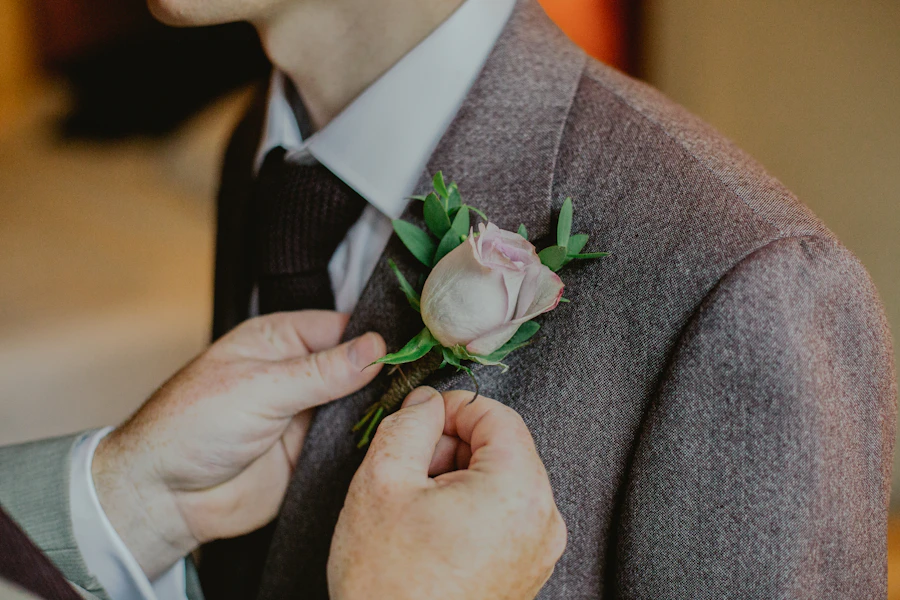
Pinning is the part people find tricky. Here's the method we teach at the shop:
- Step 1: left lapel, always. The boutonniere goes on the wearer's left side, over the heart, just below the collar point. If there's a working buttonhole there, insert the stem through it first.
- Step 2: angle the stem down. Holding the boutonniere steady against the lapel with one hand, keep the bloom facing up and the stem pointing toward the floor. It should sit naturally along the line of the lapel rather than sticking straight out. Holding it in place while you judge the angle is easier with a mirror.
- Step 3: pin from behind. Flip the lapel over. Push the pin through the clothing, across the back of the stem, and back through the fabric. Done right, the pin stays hidden and the front looks clean.
- Step 4: add a second pin. One pin lets the flower spin and sag by the end of the night. Add a second pin crossed over the first in an X and the stem is secure. Two pins is the difference between a boutonniere that stays secure all night and one that spins, so pin twice and forget about it. Every boutonniere we send out includes two pearl pins for this reason.
Give the lapel a gentle shake when you're done. If the bloom wobbles, pin it again now rather than during photos. It takes ten seconds and saves the look all night. On a knit or a delicate suit where a pin would leave a mark, magnetic backings are an optional alternative, though they hold less weight.
Wrist Corsage or Pinned Corsage?

Ordering a corsage means one more choice: wrist or pin-on? Our honest advice is wrist, almost every time. A pinned corsage puts holes in delicate dress fabric, and thin straps or strapless attire give you nowhere to pin at all. A wrist corsage goes on in two seconds and survives a crowded dance floor far better.
The exception is a formal daytime case where the wearer will mostly be seated, like a luncheon honoring a grandmother. There, a pinned corsage on a structured jacket looks classic and stays out of the way of handshakes and plates.
Choosing Flowers That Hold Up
A boutonniere spends eight hours or more out of water, pressed against a warm lapel. Some flowers handle that. Some quit by dinner.
The workhorses are carnations, spray roses, standard roses, orchids, and ranunculus. Carnations are underrated: they take abuse, hold their shape, and come in nearly any color. Dendrobium orchids look delicate but last remarkably well. Skip open tulips, gardenias, and anything that bruises when you look at it. Hydrangea florets fade fast without water, so use them only as small accents. A high-heat outdoor ceremony in August is the hardest test of all, and low humidity is no kinder, so that's when carnations earn their keep.
When you choose colors, mirror one element rather than the whole outfit. Pull the ribbon from her dress, or repeat a single flower from the bridal bouquet so the boutonnière complements it. A head-to-toe color match reads more costume than elegance; one shared detail carries the same elegance with far less effort. For a wedding palette, our guide to popular wedding flowers for bridal bouquets is a good place to start, and our wedding florist team handles full ceremonies from bouquets down to the last buttonhole bloom.
Boutonniere Styles Worth Knowing
Three style directions cover most of what we make. The classic single rose or carnation reads formal today just as it did a century ago, and it photographs cleanly against any outfit, dark or light. The garden style adds seeded eucalyptus, wax flower, or a sprig of berries for texture, and it suits outdoor weddings well. The modern minimal style skips filler entirely: one bloom, one wrapped stem, nothing else.
Price tracks complexity more than size, so a simple design in a premium flower often costs about the same as a fuller design in carnations. If the wedding party is large, picking one style and one flower for the groomsmen keeps the look consistent and the order easy to manage.
When to Order for Weddings, Prom, and Homecoming
At weddings, corsages and boutonnieres ride along with the rest of the floral order, so they're settled weeks ahead and the price is locked in with everything else. For prom and homecoming, order one to two weeks out. That gives your florist time to match ribbon to a dress photo and source specific flowers. Homecoming and fall weddings overlap: homecoming lands in September and early October in most towns while fall weddings are still running, so late August is the best window to order.
Forgot until the last minute? It happens every year. A quick search for a local shop, or a search for same-day flowers near you, will usually turn up someone who can make a simple boutonnière in time. Order by 2:00 PM Monday through Saturday, or 12:00 PM on Sunday, in the recipient's local time zone, and we can hand deliver it that day. For dances, we recommend the flowers arrive the day of the event rather than earlier. For summer weddings, day-of delivery matters even more, no matter how careful the storage.
Current styles are in our prom corsage and boutonniere collection, all made fresh and hand delivered near you.
Care Tips: Making It Last
Keep the boutonniere and corsage refrigerated in their box until you leave, away from fruit. Mist them lightly if the florist says the flowers can take it. Two more tips: don't let the box sit in a hot car, where high cabin temperatures wilt petals in under an hour, and handle the bloom by the stem, since finger oils highlight bruises on pale petals.
After the event, many people want to keep the corsage. Air drying upside down preserves the beauty of the flowers reasonably well, and we cover better methods in our guide on how to preserve flowers. One more thing: keep the extra pins. You'll want them at the next wedding.
Ready to order? Browse corsages and boutonnieres for any formal event, or explore our full range of fresh flower arrangements, created by the same family of florists since 1903.


